
Okay.
Let’s talk about noise.
The internet feels like a crowded bar where everyone is talking at once and somehow you are supposed to hear one specific person explain something complicated to you over the bass thumping in the background. You open a tab. Then another. Then another. Suddenly you have nine tabs, your laptop fan is doing that little jet-engine thing, and you still don’t really know what the product does.
Relatable?
I’ve been there. You’ve been there. We all have.
Every product page promises clarity. Every headline swears it is “the simplest way to finally solve X.” And then you scroll. And scroll. And scroll. Your eyes glaze over. You start reading but not really reading. That weird half-reading where your brain is technically awake but spiritually checked out.
And yet.
A good explainer video still punches through.
I’ve watched this happen in real rooms with real humans (yes, actual conference rooms with bad lighting and someone’s cold coffee sweating onto the table). Someone hovers over the close button. They’re half gone. Then the video starts playing. The voice isn’t trying too hard. The visuals aren’t yelling. Thirty seconds in, their shoulders drop. There’s this tiny nod people do when something finally makes sense. It’s almost involuntary. Once you notice it, you can’t unsee it.
That nod is the work.
Explainer videos compress complexity. They take something messy and turn it into a shape your brain can hold without getting a headache. They lower the friction of understanding. They don’t demand effort. They offer relief. That difference is small on paper. In real life, it’s the difference between “meh” and “okay wait, I get this.”
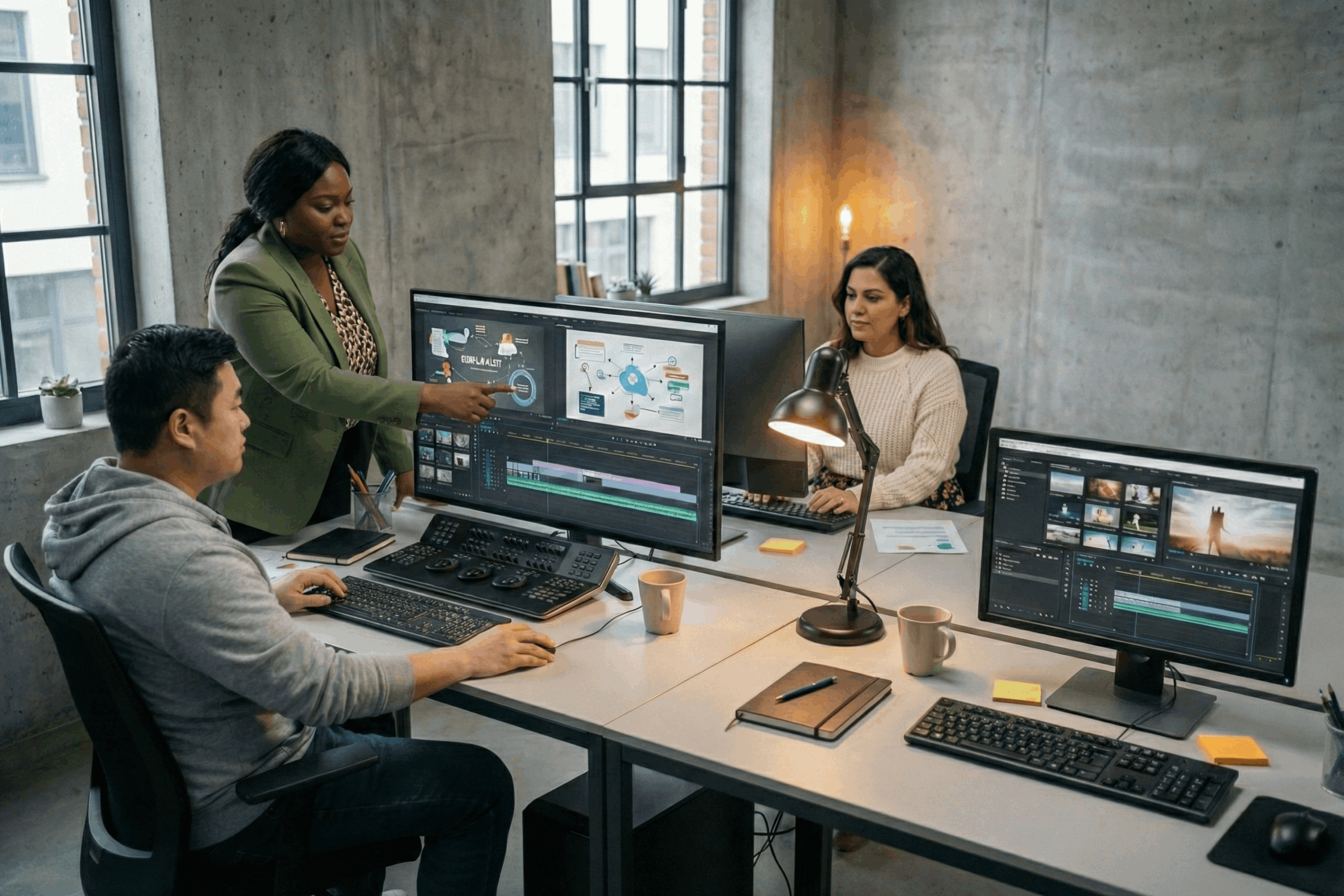
The best product explainer video companies design for that exact moment. Not for vibes. Not for flexing motion skills. They design for comprehension. They choreograph attention. They decide, frame by frame, what you should care about right now and what can wait until later.
Because let’s be honest.
Everyone’s tired.
You. Me. Your buyer. Probably the intern who had to schedule the demo link.
Clarity is not just nice to have anymore. It’s a kindness. And kindness gets remembered.
This guide is a map. Not a hype piece. Not a “just trust your gut” manifesto. We’re gonna talk about what product explainer videos actually are, why they still work when so many formats feel stale, and how the best product explainer video companies think about story, message, and outcomes. We’ll also get into how to choose a partner without getting hypnotized by pretty motion and forgetting to ask, “Wait, does this actually make sense?”
No fluff.
No “make it pop.”
Just craft, strategy, and a few truths that might sting a little (but in a helpful way, I promise).
Why Explainer Videos Still Lead
Because nobody wakes up excited to learn your product.
They wake up wanting their problem to go away.
That’s the whole psychological game right there. People are not browsing your SaaS tool or consumer app for entertainment. They’re trying to fix something that is broken, slow, annoying, or expensive. Explainer videos still lead because they meet that moment of friction with empathy instead of ego.
In practice, a tight 60 to 90 second explainer can outperform an entire landing page. Not because copy is dead (it’s not, please relax). But because motion plus voice plus pacing lowers the mental tax. It’s easier to listen than to decode dense text. It’s easier to watch than to parse jargon at 9:12 a.m. while your coffee is still negotiating with your soul.
Explainers also move well across the funnel.
At the top, they create just enough understanding to spark curiosity without demanding commitment.
In the middle, they frame your solution so it feels like the natural next step, not a wild leap.
At the bottom, they give people permission to feel smart about a decision they already want to make.
This isn’t magic.
It’s sequencing.
The best product explainer video companies design for that sequence on purpose. They don’t dump onboarding into a first impression. They don’t open with ten features because the product team got excited. They choose one promise and build the story around that spine.
Format matters here too.
Animation is still the workhorse because it can show invisible stuff. Data flows. System logic. All the weird backend things no one wants to read about. Motion graphics bring order to chaos. They turn product sprawl into something your eyes can follow without panic. Mixed media, when done with taste, grounds the story in reality without cluttering the explanation.
When all of this works, the next step feels obvious.
Not forced. Not confusing. Just obvious.
That’s the real KPI. Not views. Not applause. Whether someone finishes the video knowing what the product is, who it’s for, and what they should probably do next. That’s why the best product explainer video companies care about structure more than spectacle.
What Is a Product Explainer Video?
A product explainer video is a short, story-driven piece built to answer four questions without wasting anyone’s patience.
What is this?
Who is it for?
Why should I care right now?
What do I do next?
That’s the job.
Not a documentary.
Not a brand anthem.
Not a moody commercial with cinematic fog and zero information.
Think of it as an elevator pitch that learned how to use sound, motion, and timing. The goal is not to teach every feature. The goal is to make the value click. Once that happens, everything else gets easier.
Most effective explainers follow a familiar backbone, even when they pretend to be unique.
Hook (0 to 10 seconds):
A moment of recognition. A pain that feels personal. Or a visual that makes you stop scrolling.
Problem (10 to 25 seconds):
The friction, in the viewer’s language. Not your internal acronyms. The words someone would actually type into Slack when something breaks.
Promise (25 to 45 seconds):
The core shift your product creates. One change. Not the entire roadmap.
Proof (45 to 70 seconds):
Two or three outcomes. Less “enterprise-grade.” More “you finish in minutes instead of hours.”
CTA (70 to 90 seconds):
One next step. One lane. Not a buffet of options that makes people freeze.
Explainers are not demos.
They’re not brand films.
They’re not TV spots.
They borrow from all three, sure. But their job is understanding plus momentum. The best product explainer video companies treat the script like UX. Every line either reduces friction or increases desire. If it does neither, it usually dies in revision three (RIP to many beautiful sentences I personally loved).
What Makes a Great Explainer Video Company?
You can spot a decent studio in seconds.
You can spot a great one in a conversation.
The difference isn’t software. Everyone has After Effects. The difference is how a team thinks when the reel isn’t playing. The best product explainer video companies are not just animators. They’re translators. They turn what you mean into what your buyer hears.
Here’s what actually separates the best product explainer video companies from the “this looks cool on Dribbble” crowd.
Strong Scriptwriting & Messaging
The script is the product.
Everything else is packaging.
If the writing is fuzzy, the animation just makes the fuzz shinier. Good studios obsess over message. They poke at your positioning. They ask uncomfortable questions about who this is really for. They push you to pick one promise instead of six. This part is awkward. It’s also where clarity shows up.
You can hear it in the lines. Strong scripts sound like a person talking to another person. Not a press release wearing human skin. They lead with benefits. They move cleanly from problem to promise. They avoid buzzwords like potholes on a badly maintained street.
When you’re comparing the best product explainer video companies, read scripts, not just watch reels. Ask why they chose certain beats. Ask what they cut. Their answers will tell you how they think when tradeoffs are real.
High-Quality Design, Animation & Production
Design isn’t decoration.
It’s comprehension.
Good design makes ideas legible. Great animation uses timing and pacing to guide your attention. You should feel when a moment matters. You should know where to look without being told.
In animation, that means clean visual systems and motion that breathes. In live-action, it means lighting that feels intentional and casting that matches the audience. Sound matters more than people admit. Music should support emotion, not hijack it. Voiceover should feel like a guide, not a megaphone.
When you scan work from the best product explainer video companies, look for consistency. Not every frame needs to be flashy. But the baseline of craft should be solid across projects.
Clear Communication & Smooth Workflow
Process is invisible until it breaks.
Then it’s the only thing you can see.
Good studios run projects like grown-ups. There’s a sequence. Discovery. Script. Storyboard. Style frames. Animatic. Production. Sound. Delivery. You always know what’s next and what “final” actually means.
Feedback is centralized. Revisions are scoped. Timelines are real. There’s one point of contact who owns the relationship and the outcome.
When people quietly praise the best product explainer video companies, this is usually why. Not because the studio dazzled them once, but because the process didn’t make them want to scream into a pillow at midnight.
Ability to Simplify Complex Products
If your product is simple, lots of studios can make a decent explainer.
If your product is complex, the field thins fast.
APIs. Compliance flows. AI tooling. Fintech rails. None of this is naturally cinematic. It requires translation without distortion. The best product explainer video companies can sit with subject matter experts, absorb nuance, then re-express the value in language a non-expert can follow without feeling dumb.
This is where the best teams quietly show their depth. They know which technical details matter and which are just internal trivia. They preserve credibility without drowning the viewer in acronyms.
Ask for examples in your complexity class. Ask how they handled accuracy. The way a studio talks about this tells you a lot about how seriously they take understanding.
Proven Portfolio With Consistent Results
One great video can be luck.
A body of solid work is a signal.
Look for range. Different industries. Different tones. But also look for a consistent floor. Are the scripts sharp across projects? Or is there one standout and a lot of filler? Does the clarity hold for the full runtime or fade after the opening hook?
Even without metrics, you can feel when a video understands its audience. The pacing. The vocabulary. The emotional temperature. The best product explainer video companies make work that feels like it belongs in the buyer’s world, not just on a studio’s homepage.
Transparent Pricing & Flexible Packages
Ambiguity kills trust.
Clear pricing ranges, broken into understandable pieces, signal maturity. Script. Design. Animation. VO. Music. Revisions. Usage. These should not be mysteries revealed at the invoice stage.
Flexibility matters too. Not every project needs bespoke everything. Sometimes you need a fast, semi-custom piece to hit a launch window that is already breathing down your neck. The best product explainer video companies can right-size the solution without treating every brief like a film festival submission.
If a studio can explain where your money goes, they’re probably worth spending it with.
Best Product Explainer Video Companies (2026)
Alright.
This is the part you probably scrolled for.
No shame. I do it too. You skim the setup, nod politely at the strategy talk, and then your eyes go hunting for names. Cool, cool… who do I actually email? That’s the real question. So here’s a grounded list of teams that can take complicated products and make them feel… less like homework.
These aren’t hype picks. Not “they went viral once” picks. These are studios with repeatable thinking and enough battle scars to know where explainer videos quietly fall apart when nobody’s watching the timeline bar.
This is a practical shortlist of the best product explainer video companies heading into 2026.
1. Sparkhouse
Why they’re on the list:
Sparkhouse lives in that rare overlap between creative storytelling and performance thinking. Their explainers don’t just look good on a reel. They’re built to move someone from “wait, what is this?” to “ohhh, okay” and then toward an actual next step. You can feel the intentionality in the pacing, like someone actually mapped the viewer’s attention instead of hoping for the best.
Best for:
Growth-focused brands, DTC products, and teams who care about clarity and conversion in the same breath (which, honestly, should be most teams).
Where they shine:
They’re especially good at blending live-action with motion graphics in a way that feels natural. Not the awkward late-night overlay of floating UI boxes on top of footage. More like real people in real environments, with just enough visual guidance layered in to keep things legible. If you’ve watched explainers on thesparkhouse.com, you’ll notice the rhythm feels human, not templated.
Watch for:
Get alignment on outcomes early. If the goal is demo requests, signups, or something more specific, say it out loud. When Sparkhouse has a clear target, the scripting tends to snap into focus fast (you can almost feel the story “click” into place).
2. Yum Yum Videos
Why they’re on the list:
Yum Yum Videos is quietly dependable. Not flashy for the sake of it. Just clean, polished explainers that do the job they’re supposed to do. There’s a weird comfort in knowing a studio is not going to turn your straightforward brief into an interpretive dance.
Best for:
SaaS, startups, and SMBs that want reliable production value without turning the project into an existential art debate.
Where they shine:
Friendly illustration styles, simple color systems, and voiceovers that sound like actual people, not someone reading your pricing page in a vacuum booth. Their pacing respects attention spans, which, let’s be real, are hanging on by a thread lately.
Watch for:
If you want something visually strange or edgy, push for that early. Their default mode is clarity and polish, not experimental art direction.
3. Demo Duck
Why they’re on the list:
Demo Duck tends to think about the “why” before the “how.” Their explainers usually feel like someone actually organized the story before hitting animate. You’re not scrambling to piece together what the product does by the end. The narrative has a backbone.
Best for:
B2B products, regulated spaces, and anything where accuracy matters but boredom is still very much the enemy.
Where they shine:
Message hierarchy. Their scripts usually feel structured. You can tell someone made real choices about what comes first instead of dumping everything into the middle and hoping it sorts itself out.
Watch for:
Loop in your product folks early. The more nuance Demo Duck gets during discovery, the less backtracking you’ll deal with later (and yes, this saves money, not just feelings).
4. Sandwich Video
Why they’re on the list:
Sandwich is one of those names people casually drop in tech like everyone’s supposed to know them. And honestly, you probably do. Their live-action explainers feel cinematic in a way that makes people actually watch ads, which still feels mildly impossible in 2026.
Best for:
Consumer tech, apps, and hardware where seeing the product in real life sells the story better than any animated diagram ever could.
Where they shine:
Casting and comedic timing. Their actors don’t feel like actors. They feel like people you’d bump into at a coffee shop in Palo Alto or Brooklyn. That everyday-ness does a ton of emotional work.
Watch for:
Live-action brings logistics. Locations, schedules, weather, permits, random chaos. If your timeline is tight, pad it. Then pad it again (future you will be grateful).
5. Thinkmojo
Why they’re on the list:
Thinkmojo has that clean, premium SaaS energy. Their motion design is tidy, their typography is disciplined, and their explainers often slot nicely into larger product education ecosystems.
Best for:
Product-led growth teams building onboarding flows, feature explainers, and in-app education that needs to feel like part of one coherent system.
Where they shine:
Motion systems. They’re good at creating a visual language you can reuse across multiple videos so everything feels like it belongs to the same product family.
Watch for:
Bring your design system to the table early. UI kits, brand tokens, all of it. The more context they have, the less guesswork later.
6. Epipheo
Why they’re on the list:
Epipheo leans into emotion more than most. Their explainers often start with the human frustration before sliding the product into frame as the answer. When that lands, it really lands.
Best for:
Mission-driven brands, education, and products that benefit from narrative more than raw feature explanation.
Where they shine:
Empathy in scripting. Their videos tend to “get” the viewer’s pain before offering relief, which sounds simple and is actually very hard to do without getting cheesy.
Watch for:
If your goal is purely tactical, be explicit. Otherwise the story layer might go deeper than you planned for.
7. Wyzowl
Why they’re on the list:
Wyzowl has volume on their side. They’ve produced a ton of explainer videos over the years, and that repetition builds serious process muscle. You feel it in how predictable their timelines and workflows are.
Best for:
Teams that want reliability, speed, and a process that feels plug-and-play.
Where they shine:
Consistency. You generally know what you’re getting and when you’re getting it. That sounds boring. It’s actually very calming when deadlines matter.
Watch for:
If you want a distinctive visual style, you may need to push for customization. Their strength is “done well and on time,” not “reinvent the visual language of your brand.”
8. Explainify
Why they’re on the list:
Explainify focuses on making complicated products feel understandable. Their 2D animated explainers strip away jargon and focus on outcomes, which sounds easy and is absolutely not.
Best for:
B2B software, fintech, developer tools, and anything that usually takes three slides to explain in a sales deck.
Where they shine:
Clear, non-jargony scripts. They’re good at translating product speak into something a buyer might actually repeat to their boss without sounding like they memorized a pitch deck.
Watch for:
The more you share real sales objections, the sharper their translation tends to be.
9. Studio Pigeon
Why they’re on the list:
Studio Pigeon leans design-forward. Their explainers often feel like brand pieces first and functional product videos second. For some teams, that’s exactly the goal.
Best for:
Brands where visual identity is part of the product’s perceived value.
Where they shine:
Illustration detail, motion finesse, and thoughtful sound design. Their frames are the kind you pause on (which is rare for explainers, let’s be honest).
Watch for:
Bespoke craft takes time. If you’re racing a launch date, align on timelines early so nobody’s surprised later.
10. Breadnbeyond
Why they’re on the list:
Breadnbeyond is practical. Their packages are cost-conscious, their turnaround times are fast, and their output is clean enough to ship without embarrassment. Sometimes that’s exactly what you need.
Best for:
Startups and SMBs that want professional explainers without enterprise-level budgets.
Where they shine:
Speed and efficiency. If you need something live soon and don’t have months to workshop art direction, they’re built for that pace.
Watch for:
Templates save time, but they can feel generic if leaned on too hard. Semi-custom options help you stand out a bit more.
TL;DR:
Whether you’re leaning budget, polish, live-action, or design-forward, this mix gives you a grounded snapshot of the best product explainer video companies heading into 2026.
How to Choose the Right Explainer Video Partner
This is where projects quietly live or die.
Not in the animation software.
Not in the color palette.
In the partner choice.
I’ve seen gorgeous explainers flop because the studio didn’t really understand the buyer. I’ve also seen simple videos outperform entire landing pages because the team nailed the message. That gap usually isn’t about talent. It’s about fit.
Here’s how to choose without getting hypnotized by pretty motion.
Match Their Style to Your Product Complexity
Start here. Seriously.
If your product is complex, you don’t just need animators. You need translators. People who can sit with technical nuance and then explain it back in one sentence your buyer can follow. Not every studio can do that, even if their reel looks incredible.
If your product is tactile, live-action or mixed media can ground the story. Seeing a real hand tap a real screen does something to the brain. It makes the product feel real, not theoretical.
Quick test:
Explain a tricky feature to the studio. Then ask them to explain it back to you in one sentence. If it’s still accurate and suddenly feels simple, you’re probably talking to one of the best product explainer video companies. If it turns into buzzword soup, that’s your cue.
Evaluate Scriptwriting Strength Above All Else
Animation cannot fix a fuzzy message.
I wish it could. It cannot.
Ask for script samples. Read them without the visuals. Do they sound like a human talking to another human? Or do they sound like a website that swallowed a thesaurus?
Strong explainer scripts feel like good product marketing. Audience-first. Promise-led. Clean transitions. No feature salad.
Red flags I’ve personally tripped over:
Feature lists pretending to be stories.
Jargon only insiders understand.
CTAs that try to do three things at once (ARE YOU KIDDING ME).
When you compare the best product explainer video companies, weight script quality above everything else. Motion is visible. Messaging is decisive.
Explainer Video Pricing: What to Expect
Okay, numbers.
This is the part everyone pretends not to care about and then secretly obsesses over in a Google Sheet at 11:47 p.m.
“How much does an explainer video cost?” is one of those questions that sounds simple and then immediately turns into, “Well… it depends.” Which is annoying. But also true. Still, you deserve ranges that don’t feel like they were pulled from thin air.
Here’s the rough reality of what the best product explainer video companies tend to charge in the wild.
Typical Cost Ranges
Budget animation: $1k to $5k
Mid-tier custom animation: $5k to $15k
High-end animation or live-action: $15k to $50k+
These ranges usually assume a 60 to 90 second explainer with a standard number of revision rounds. Not infinite revisions. Not “my cousin had an idea last night” revisions. Normal revisions. Add 3D, character-heavy animation, complex UI simulations, or longer runtimes and the number climbs fast. Live-action stacks even more variables. Crew. Locations. Casting. Production design. Post-production. Suddenly you are negotiating with reality.
If you’ve ever wondered where the money goes, most of it goes to time. Storyboarding. Animation passes. Sound mixing. These things take real human hours. No amount of software shortcuts has changed that fundamental math.
Factors That Change Pricing
Animation complexity:
Character rigs. 3D scenes. Simulations. Dense UI flows. More moving parts means more hours. It’s not personal. It’s physics.
Scriptwriting needs:
If your messaging is still fuzzy, you are paying for thinking time, not just typing time. A clean script often takes more effort than a messy one (which feels unfair, but here we are).
Character or brand assets:
Custom illustration systems and motion guidelines are an investment. They hurt once. Then they quietly pay off across future content when you are not reinventing the visual wheel every time.
Length and revisions:
Every extra 15 to 30 seconds adds shots, transitions, and sound design. Every extra revision round adds labor. This is the part people underestimate and then act surprised about later.
Small side note from personal experience (and yes, I learned this the hard way):
If your budget is fixed, protect the early phases. It is cheaper to simplify animation than it is to unscramble a story after it has already been animated. Once frames exist, everything gets more expensive to change. EVERYTHING.
Frequently Asked Questions
This is the part where the questions get repetitive and somehow still feel important every single time.
So let’s just answer them cleanly.
Why do brands invest in explainer videos?
Because confusion is expensive.
And clarity, quietly, makes money.
I have personally rage-closed more product pages than I care to admit because I could not figure out what the thing actually did in the first 20 seconds. Maybe it was brilliant. Maybe it would have saved me hours a week. I will never know. My brain hit the eject button.
Explainers exist to stop that moment.
They step in before the bounce.
They say, “Here’s what this is. Here’s why it might matter to you.”
That translation layer is the whole value.
There’s also a boring, practical upside nobody likes to put on slides. One solid explainer ends up everywhere. Homepage. Sales decks. Paid ads. Email campaigns. Onboarding docs. Sometimes internal training, which is always a little funny and a little revealing. You are not just paying for a video. You are paying for a shared story your whole team can point to when someone asks, “So… what do we actually do?”
And yes, explainers convert. Not because they are magical. But because they remove mental friction. When people understand, they relax. When they relax, they are more willing to act. That is the psychology no one brags about, but everyone benefits from.
How long should an explainer video be?
Short enough that someone finishes it.
Long enough that it actually says something useful.
For most awareness and conversion use cases, 60 to 90 seconds is still the sweet spot. It is long enough to set up the problem, land the promise, show a couple proof points, and make one ask. It is short enough that someone will watch it without feeling like they accidentally signed up for homework.
Longer explainers can work later in the journey. Onboarding. Feature education. Sales enablement. But if your very first explainer is pushing three minutes, it usually means the story is not tight yet. It usually means too many stakeholders wanted their favorite feature “just mentioned real quick.” (Those are famous last words.)
The real rule is this: minimum time required to make the value obvious. If you are padding for safety, the viewer can feel it. People are weirdly good at sensing when they are being asked to sit through extra stuff they did not agree to.
How long does production take?
Longer than the kickoff optimism.
Shorter than the emotional experience of waiting for approvals.
On the fast end, template-heavy or semi-custom explainers can ship in two to three weeks. On the custom end, six to ten weeks is normal, especially if you are doing discovery, original illustration, custom animation, and multiple approval rounds.
What actually stretches timelines is not animation. It is alignment. Script debates. Brand nuance. Legal notes. Someone being on vacation when feedback is due. The best product explainer video companies build schedules around these realities because they have been burned by “it’ll be quick” before.
If you are under the gun, the biggest unlock is locking the script early. Late copy changes ripple through everything. Timing shifts. Animation tweaks. VO re-records. Music re-cuts. Suddenly your “tiny change” becomes a three-day detour.
What’s the difference between an explainer and a product demo video?
Explainers sell the why.
Demos prove the how.
An explainer answers, “Why should I care about this problem and your solution?”
A demo answers, “Okay, how do I actually use this thing?”
They live at different moments in the buyer’s head. When teams blur them together, you end up with a video that is trying to introduce the product, teach every feature, and walk through UI flows all at once. That is not ambitious. That is confused.
The strongest setups pair them. The explainer earns attention. The demo earns commitment. If your explainer is doing demo work, it is probably too detailed. If your demo is doing positioning work, it is probably too vague. Each format has a job. Let them do it.
What should be included in an effective explainer script?
A hook that feels personal.
One core promise you are willing to bet on.
Two or three proof beats tied to outcomes.
One CTA. Just one.
That is the spine.
Write in plain language. Then read it out loud. Actually out loud. If you trip over a sentence, your viewer will trip over the idea. If it sounds like something you would say to a teammate when they ask, “Wait, what does this product do?”, you are close. If it sounds like corporate bingo night, it needs another pass.
Also (and this part hurts a little): great scripts are defined by what they leave out. You are choosing not to mention ten things so that one thing lands. That is not loss. That is focus.
Key Takeaway
Okay.
Deep breath.
If you’ve made it this far, you’re probably not just casually browsing. You’re either about to commission an explainer video, or you’ve already lived through one and you’re trying to not repeat the parts that made you quietly question your life choices. Both are valid places to be.
Here’s the unsexy truth.
This whole thing is not about picking the flashiest animation style.
It never was.
It’s about finding a partner who can take something that lives in your head and turn it into something that lands in someone else’s head without getting mangled along the way. That translation layer is the job. The motion, the music, the polish, all of that is just the delivery system.
The best product explainer video companies get this. They do not treat your explainer like a vibe piece. They treat it like a clarity tool. They ask uncomfortable questions early so the story does not fall apart late. They cut things you like so the thing your audience needs can breathe. That can feel personal in the moment. It usually pays off later.
If you’re choosing a partner, a few anchors are worth holding onto.
Match the studio’s style to your product’s complexity.
If your product is dense, regulated, or technically nuanced, you want translators. People who can sit with the messy truth of how your product actually works and then explain it without sounding like a glossary. Not every studio can do that. The best product explainer video companies can, and they tend to prove it in conversation before they ever prove it in a reel.
Judge scripts before you judge motion.
This one is boring advice. It is also the advice that saves projects. Beautiful animation cannot rescue a fuzzy story. If the message is muddy on paper, it will be muddy in motion. Read scripts. Out loud. Notice where you stumble. Notice where you zone out. That is where your audience will stumble and zone out too.
Look past highlight reels.
Reels are snacks. You need meals. Ask to see full pieces. Watch the pacing across the entire runtime. Does the clarity hold, or does the video burn all its energy in the first 15 seconds and then meander? The best product explainer video companies are consistent, not just occasionally impressive.
Get explicit about timelines and pricing.
Ambiguity creates stress. Stress creates bad decisions. Clear timelines, scoped revisions, and transparent pricing do more for a project’s success than any single animation trick. When everyone knows what “done” means, things move faster. When nobody knows, things drag.
There is also a quieter benefit to getting this right.
A good explainer becomes a shared reference point inside your company. Sales uses it. Marketing points to it. New hires watch it. Suddenly everyone is telling the same story instead of twelve slightly different versions. That alignment alone is often worth the investment, even before you look at conversion metrics.
And yeah, metrics matter.
But clarity comes first.
People do not act on what they do not understand. The job of an explainer is to remove that friction. The job of the best product explainer video companies is to make that removal feel natural, almost invisible. When it works, it does not feel like persuasion. It feels like relief.
You ship the video.
Someone watches it.
Their shoulders drop a little.
They think, “Oh. I get this.”
That moment is small.
It’s also the moment everything else gets easier.